The Religions of Atlantis
The Quiet Guide
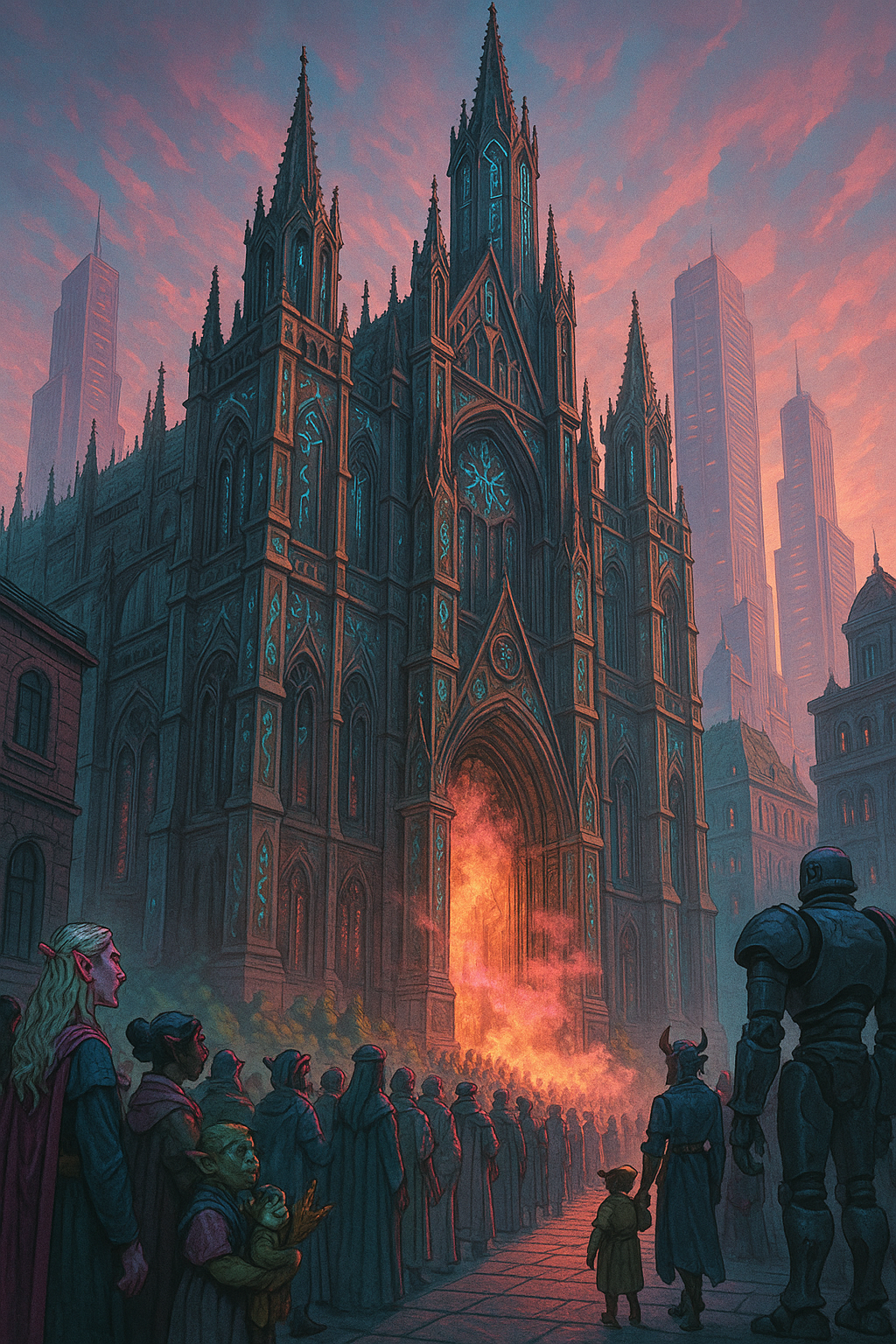
The Cathedral of Saint Arva loomed above me, spires stabbing at the sky like they meant to pierce the Star itself. Its doors yawned wide, and incense smoke spilled into the streets, thick and sweet enough to sting the throat. Inside, the air was heavy - every word echoed, like the gods themselves were listening. Maybe they were.
A cleric in robes the color of dried blood led me past statues of the Ten. Aurex with her bound eyes, Foster cradling a seedling, Ramone dancing in painted flame. We stopped before the miracle exchange, where a quill burned through parchment as fast as the petitioner spoke. My name, my lineage, the weight of my piety measured like coin. When it was done, I pressed a thumb into hot wax. My flesh hissed. The loan was sealed. Whatever miracle I asked, I owed now. The church always collects.
The cleric guided me to the waiting lines. All around me, miracles unfolded like theater: A black furred Simian artisan fell to his knees, eyes glowing, as Konner Brass set his mind alight with visions of a new masterpiece. A family of goblins wept as cleric of Foster laid hands on the mother’s belly - a brood of children promised. An old elf gasped and began weeping while his family gathered to embrace him. Memories of children long lost - now returned by Mnemoris.
Then the crowd shifted, hushed. A man shrieked as his tongue blackened and his knees shattered. He’d sworn falsely in Aurex’s name. Ostranox, the Final Judge, had passed sentence. The clerics dragged him away, still trying to scream through his ruined mouth.
My turn came. The cleric asked my request. My throat tightened. “I ask to see Mourn,” I whispered. His expression did not change, but he wrote it down, the ink bleeding blacker than before.
I stepped forward, past the glowing shrines, into the shadow where the Quiet Guide waited.
The Pan Pantheon
The Pan Pantheon is Atlantis’ dominant religious order. Ten gods embody the five alignments: Order, Knowledge, Passion, Life, and Void. Each representing opposing but interwoven ideals. They are not distant: their miracles are real, visible, and public.
How it works in practice:
- Worshippers enter a Cathedral (Saint Arva’s Basilica being the greatest) and petition for a miracle.
- Their faith is measured like currency: piety, loyalty, or coin.
- Miracles are granted directly: healing, inspiration, judgment, even fertility.
- The cost is always collected. Sometimes it’s coin. Sometimes service. Sometimes it’s your life. If you cannot pay now, you can loan, but remember that in the end - debts are always paid in full.
The Pantheon’s character:
- The faithful see it as a safety net: healers, protectors, blessings for their families.
- Critics see it as tyrannical and mercantile: Anything out of the Pan Pantheons' dogma is treated harshly or even judged to be heretical. In the latter case the Church inquisitors or the Choir of Silence (the secret service) make sure to root out the heretics.
- The gods are present and political, invoked daily in courts, contracts, forges, art studios, even kitchens.
⚖️ On Divine Access:
- Clerics & Paladins must be registered with the Pan Pantheon, taking sacred oaths bound by divine contract.
- "Unlicensed" worship of any unregistered god is punished as spiritual treason.
- Miracles not sanctioned by the Pantheon are hunted down and erased by the Choir of Silence.
- Miracles and rituals can be purchased by citizens in offerings of glyph, labor or information).
Gameplay implications:
- Druids: manifest the powers of the nature. They should think if their power comes from some Pantheon God, nature God (unlicensed) or just a pure power of nature (can be seen as heresy)
- Seraphs: If you see a Seraph in the Atlantis, they are most likely a Paladin or other agent of the Pan Pantheon. Seraphs of unsanctioned gods are relentlessly hunted down as demons or heretics.
- Other Magic users: Magic and miracles are divided by a line drawn on water. Small "tricks" like fireballs or snaring wines are usually categorized as magic, as are any feats achieved by Arcanum powered machines. Bigger spells might be mistaken for minor miracles, and unauthorized miracles are a heresy in the eyes of the Pantheon.
- Infernis: As a race the Infernis are the descendants of the demons in the Circles Below. They are not exactly hunted by the Pantheon, but they will face extreme prejudice and outright racism when dealing with church officials.
The Gods:
The gods inhabit the The Hallows Above, which are the collection of deific territories that once belonged to the Forgotten Gods before the New Gods claimed it at the end of the Earliest Age. Because this place is closely connected with most other realms, the gods residing here can see and speak with the creatures of the Mortal Realm without leaving their domain.
There are many gods and spirits that inhabit the Hallows above, some of the the mightiest among them have formed the Pan Pantheon in Atlantis. Other kingdoms and tribes might follow different gods, but they should tread carefully on the Pan Pantheon home soil.
The Ten Guardians of the Pan Pantheon
| Name | Alignment | Miracles | Typical Imagery |
|---|---|---|---|
| Aurex, the Seal-Keeper | Order | Unbreakable oaths, binding contracts, truth enforced | Blindfolded human/elf/galapa woman with sword and bound eyes |
| Atlas, the Shieldfather | Order | Protection, wards, shields, guardianship of city and state | Male Giant holding a massive shield, or lifting Atlantis itself on his back |
| Mnemoris, the Keeper of Truth | Knowledge | Perfect recall, revelation of forgotten laws or spells, oblivion of unwanted memories | Hunched elven elder with scrolls, or a (more modern interpretation) Clanker scribe inscribing endlessly |
| Calypso, the Light that Reveals | Knowledge | Sparks of genius, inspiration, discovery of hidden truths | Ribbet or Galapa woman with storm lantern, or mermaid illuminating dark waters |
| Konner Brass, the Hammer of Dawn | Passion | Martial strength, courage, endurance in struggle, forging of weapons and artifacts | Dwarf smith with hammer at an anvil, or Drakona warrior wreathed in forgefire |
| Ramone, the Voice on Fire | Passion | Inspiration, seduction, art that stirs rebellion and reshapes hearts | Mischievous halfling child, or flame-haired teenager dancing with neon fire |
| Foster, the Seedmother | Life | Fertility, healing, renewal, blessing crops, breathing life into the dying | Faun woman with vines coiled on arms, or Firbolg matron cradling glowing seedling |
| Mourn, the Quiet Guide | Life | Peaceful death, banishing restless spirits, merciful release, smothering unnatural life | Cloaked figure with lantern, or ferryman rowing souls across a misty sea |
| Ostranox, the Final Judge | Void | Striking down oath-breakers, binding contracts, delivering merciless judgment | Cloaked elder (mirroring Aurex) judge with sewn mouth, or faceless figure with a tome of oaths. |
| Celeste, the Sky Seer | Void | Prophecy, visions of futures, glimpses of inevitable or possible threads | Katari woman with constellation eyes and crystal ball, or Simian artisan weaving light |
References
Links: